What do North Dakota and its neighbors have in common? Social capital
Last week, I noted that North Dakota and its neighbors have very different economic policies but very similar employment outcomes. I concluded that “there is some other factor (or factors) driving high rates of employment in these states besides state economic policy.” Given the link between higher employment ratios and higher median household incomes, “[i]dentifying this “x-factor” (or factors) is important for understanding variations in economic well-being across the states.”
“What might this “x-factor” (or factors) be?,” I aked.
Social capital
While pondering this question, I came across the map in Figure 1 in a report titled The Geography of Social Capital in America produced by the Social Capital Project which is run by the Joint Economic Committee of Congress. The map shows each state’s “social capital,” with lighter colors denoting higher levels. North Dakota and its neighbors to the east and south stand out for their high levels of social capital, just as they do for their high employment ratios. Minnesota ranks 2nd, Wisconsin 3rd, and Iowa, South Dakota, and North Dakota occupy the 9th, 10th, and 11th places respectively, as Figure 2 shows.
Figure 1: Social Capital Index and Subindex Scores by State
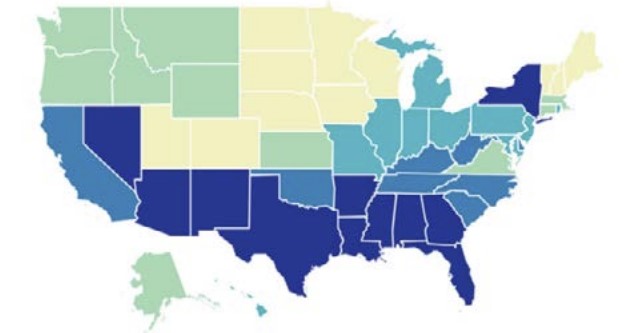
Figure 2: Social Capital Index Scores

This apparent relationship between levels of social capital and employment ratios — and, via these, median household incomes — is both positive and statistically significant: as Figure 3 shows, 58.2% of the variation in employment ratios can be attributed to variations in social capital. Social capital seems a good candidate to be one of our “x-factors.”
Figure 3: Social Capital Index Scores and Employment Ratios, 2023

These observations prompted me to explore three questions. First, what is social capital? Second, how is it related to economic well-being? And third, can policy affect it and if so, how? Stay tuned.
This article is based on my report “The X-Factor? Social capital and economic well-being: A quantitative analysis.”